12 Facts About Santorini Greece That Surprise First-Time Visitors
The short answer
Three dating methods disagree about the eruption by more than a century, nobody has ever found a body at Akrotiri, the vines grow coiled flat on the ground, and the cable car belongs to the island itself. Most of what makes this place strange is not the view.
Santorini is the most photographed island in Greece and the least understood. Here are twelve things about it that are checkable, surprising, and mostly not about the blue domes. Several of them you can only reach on a Santorini volcano tour.
1. The island is the rim of a hole
The caldera measures about 12 by 7 kilometres, with cliffs some 300 metres high on three sides and water 385 metres deep in the middle. What you stand on is what is left of a mountain, and the two dark islets in the centre are what has grown back since.
2. Nobody agrees when it blew up
Archaeological chronology, built on Bronze Age material culture, points to around 1500 BC. Radiocarbon points to between roughly 1645 and 1600 BC. Tree rings give 1628 BC. The gap is more than a century and it has not closed, so anyone giving you a single year has picked a side.
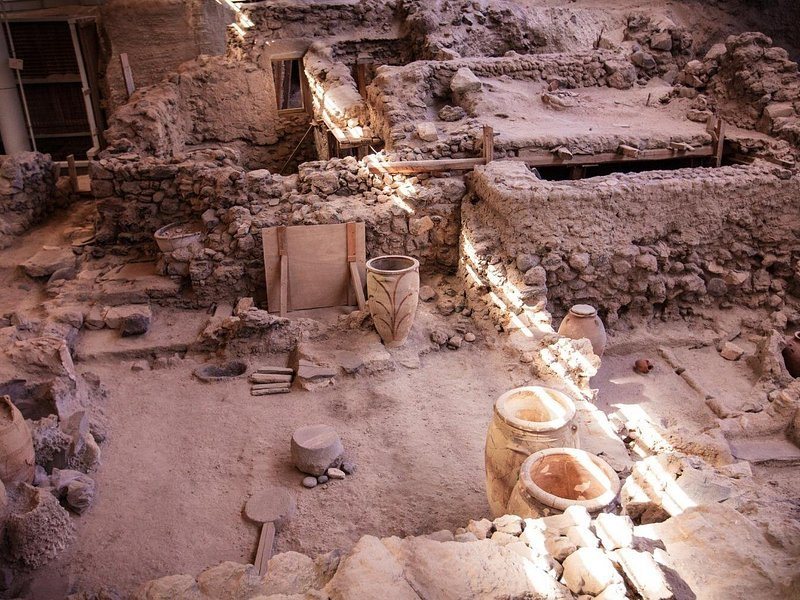
3. No one died at Akrotiri
Or at least no one has ever been found there. Ash layers weathered by winter rain between deposits show the volcano gave months of warning, and the town appears to have been emptied. It is the difference between this and Pompeii, and almost nobody arrives knowing it.
4. The eruption was one of the largest in human history
It reached VEI 7 and ejected something like 28 to 41 cubic kilometres of rock. Santorini is the most active volcanic centre in the South Aegean Volcanic Arc and one of only sixteen Decade Volcanoes worldwide, the group singled out for close study.
5. The volcano last erupted within living memory
Nea Kameni erupted in January and February 1950. That is recent enough that people on the island remember it, and it is why the rock you walk on up there has no soil on it at all.
6. The vines lie down
Santorini vines are trained low and unstaked into a basket called a kouloura, coiled on the ground so the fruit sits inside, sheltered from the wind and the sun. From a distance a vineyard here looks like a field of empty baskets.
7. The wine is made on roots that have never been grafted
The island has no phylloxera, because its volcanic soils contain none of the clay the parasite needs to survive. Many vines are therefore ungrafted and own-rooted, with root systems described as centuries old.
8. The harvest has collapsed
Production of Assyrtiko fell from 2,500 tonnes in 2022 to about 500 in 2025. Yield per hectare, which averaged 2.8 tonnes between 2005 and 2015, hit historic lows of 1.5 tonnes in 2023 and 1.0 in 2024. Grape prices went from about EUR 0.85 a kilo in 2010 to EUR 10 to 12 in 2025.
9. There is no road from the port to the capital
Cruise tenders land at the Old Port and Fira is 220 metres straight above it. The only ways up are a cable car, about 590 steps, and a mule. It is the single most consequential fact about a day here off a ship.
10. The cable car was a gift, and the island owns it
It was funded outright in 1979 by the shipowner Evangelos Nomikos, who paid for the purchase and the installation. The Foundation gave it to the municipality, and its revenue is shared among the island's fourteen communities, and a percentage of every ticket goes to the mule drivers by the foundation's own constitution.
11. The wind blows for a fortnight at a time
The meltemi is not an afternoon breeze. In July 75 per cent of days blow from the northern quadrant, and across July and August the mean longest unbroken northerly spell is seventeen days. That is why boat trips get rerouted rather than delayed.
12. The sunset moves by three and a half hours
It sets at about 20:41 at the June solstice and just after 17:00 in early December. That is why a sunset cruise leaves at three in the afternoon in one month and earlier in another, and why two operators here say in writing that their winter departures start earlier.
One more that is not a fact, but is worth knowing
Almost everything visitors photograph here is younger than it looks. The whitewash is a twentieth-century convention rather than an ancient one, and the cave houses cut into the pumice were dug because the rock is soft and the material was free, not for the view. Much of the rim you see was rebuilt after the earthquake of 9 July 1956, which different studies put between magnitude 7.5 and 7.8 and which flattened a great deal of the island.
That is worth carrying round with you, because it changes what you are looking at. The postcard is not a preserved medieval village. It is a working island that was knocked down within living memory and put back up, and then discovered by tourism afterwards.
The three eruption dates, side by side
| Method | Date | What it rests on |
|---|---|---|
| Archaeological chronology | around 1500 BC | Bronze Age material culture across the Mediterranean |
| Radiocarbon | about 1645 to 1600 BC | Organic material from the destruction layer |
| Tree rings | 1628 BC | Growth anomalies, with further ones at 1597, 1560, 1546 and 1544 BC |
Why the eruption date matters to more than archaeologists
A century is not a rounding error when you are trying to line up the Bronze Age Aegean with Egypt. If the eruption is 1600 BC, the Minoan world it damaged sits in one relationship to the Egyptian dynasties; if it is 1500 BC, that relationship changes and so does everything built on it. The disagreement is not about Santorini, it is about the whole eastern Mediterranean chronology.
The radiocarbon dates come from organic material in the destruction layer, including an olive branch buried alive by the ash. The archaeological dates come from pottery styles that can be traced across trading routes. Both methods are sound; they simply do not agree, and no amount of confidence in a guidebook closes the gap.
What the island is doing now
The volcano is monitored and it is not dormant. It is one of sixteen Decade Volcanoes precisely because it combines a serious eruptive history with a population living on top of it, and the 1950 eruption is close enough that the ground on Nea Kameni is still bare rock. Standing on it is the closest most visitors get to geology in progress.
The other thing still moving is the vineyard. Vineyard area has fallen from roughly 2,500 hectares in the 1960s to about 900 today, mostly because small plots became building land. That is why a bottle of Assyrtiko costs what it does, and why the wineries you visit are working through the hardest run in living memory.
The excavation itself is on the Akrotiri page, the islets on the volcano page, and the wind on the weather page. What you can actually book is on the Santorini Greece Tours home page, and the things-to-do page puts hours and costs against each of them.
The strangest things here are underfoot rather than in the view. Two of them you can stand on, and both need a boat.