How to Avoid the Crowds in Santorini Greece: Hours, Months and Ships
The short answer
The crowds here are not spread evenly through the day or the year. Oia fills in the two hours before sunset and empties afterwards; Fira fills when the tenders start and empties in the late afternoon. May and October give you 21 C, almost no rain and none of the July crush. The single biggest variable is how many cruise ships are in the caldera that morning.
In this guide
- Why Santorini feels full when it is not
- What time does Oia actually fill?
- How do cruise ships change your day?
- Which month should you come in?
- The year on one screen
- Is the shoulder season really quieter?
- Where the island empties out
- Watching the sunset without the crush
- What is winter like here?
- Six tactics that actually work
- Crowd questions
Why Santorini feels full when it is not
The 2021 census counted 15,480 residents on an island of about 90 square kilometres. That is not a crowded place. What makes it feel crowded is that almost everybody wants to be in the same two towns, on the same cliff edge, at the same hour of the day.
Oia at sunset is the extreme case. There is one lane with a view west, it is narrow, and the sun sets once. Everything about the island’s reputation for crowds comes from that hour and from the mornings when several ships anchor at once.
Move an hour either side of the peak and it is a different island. That is the whole trick, and it costs nothing. The Santorini sunset tour options are all built around the same hour, and the rest are on the Santorini Greece Tours home page.
What time does Oia actually fill?
The build starts roughly two hours before sunset and the crush is the final forty-five minutes. Because sunset moves through three and a half hours across the year, so does the crush — there is no fixed ‘busy time’ you can learn once.
In late June the sun goes down at about 20:39, so Oia is filling from 18:40. In mid-October it sets at 18:44 and the same build starts at 16:45, which lands right in the middle of the afternoon. Plan against the date rather than the clock.
Mornings in Oia are genuinely quiet. Walk the lane at eight and it belongs to residents and cats.
How do cruise ships change your day?
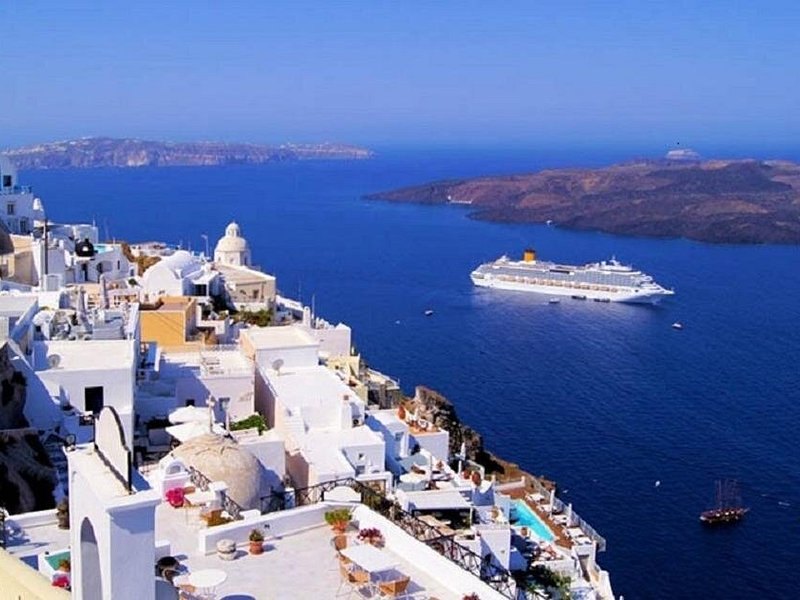
Ships anchor in the caldera and tender passengers to the Old Port below Fira, and there is no road up. The cable car is rated at 1,200 people an hour in both directions, on a three-minute ride. When several thousand people come ashore in a morning, that capacity is the bottleneck for the whole town.
The knock-on lands in Oia around the middle of the day, because that is where the excursions go. If you can look up your dates against the ship schedule before you fix your itinerary, do it — it is the highest-value hour of planning available here.
The corollary is useful: late afternoon in Fira is calm, because the ships are pulling their passengers back for all-aboard exactly when everyone else is heading for the sunset.
Which month should you come in?
May and October are the answer for most people, and the measured figures back it up rather than contradict it. May averages 21.1 C with 10 mm of rain; October averages 21.7 C with 20 mm.
They also fall outside the wind. Only 11 per cent of May days reach Beaufort 6 or more, against 41 per cent in January. July and August are hotter at 27 C and drier still, but they are the crowded months and the meltemi blows from the north on three days in four.
The year on one screen
| Month | Average high | Rain | Days at Beaufort 6+ | Sunset, 15th |
|---|---|---|---|---|
| April | 17.7 C | 15 mm | 26% | 19:52 |
| May | 21.1 C | 10 mm | 11% | 20:19 |
| June | 25.0 C | 2 mm | 11% | 20:39 |
| July | 27.0 C | 0 mm | 16% | 20:38 |
| August | 27.2 C | 1 mm | 14% | 20:11 |
| September | 25.1 C | 6 mm | 17% | 19:28 |
| October | 21.7 C | 20 mm | 19% | 18:44 |
| November | 18.5 C | 32 mm | 22% | 17:11 |
Those are thirty-year averages computed from daily reanalysis records for the island centre, 1995 to 2024. Annual rainfall works out at 299 mm, which is close enough to an independently published 316 mm for a different period to trust both.
Is the shoulder season really quieter?
Yes, and measurably so on the water rather than only in the lanes. Boat caps here are 18 to 22 people, and in May and October those boats sail with room on them; in August they sail full and sell out days ahead.
The trade is daylight and sea temperature. An October afternoon ends nearly two hours earlier than a June one, and the sea has had less summer behind it by May. If swimming is the point of your trip, June and September are the better compromise.
Where the island empties out
Almost everywhere that is not Oia or Fira. Pyrgos is a hill village with a Venetian kasteli and a view over the whole island, and it is quiet at four in the afternoon in August.
Ancient Thera sits on a ridge above the eastern coast and takes real effort to reach, which keeps the numbers down. Akrotiri is covered and ticketed at EUR 20, so it never has the standing crowd problem. Thirasia has a few hundred residents and no coach ever reaches it.
Watching the sunset without the crush
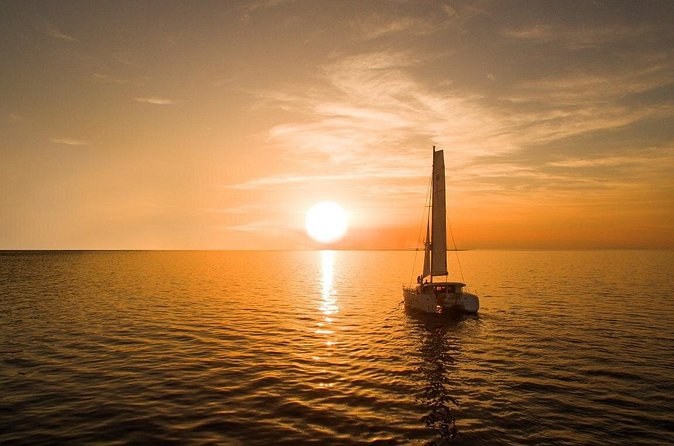
Three honest options. Watch it from Imerovigli or Firostefani, which look at the same sun over the same rim from a wider space. Watch it from a boat, which is what the sunset cruises exist for and which gives you a seat and a drink.
Or watch it from Pyrgos or Profitis Ilias, higher and further east, where you get the light on the whole island instead of the single view west. None of the three is a consolation prize.
If it has to be Oia, go on a night when no ship is in and be in place ninety minutes early. The best-time page sets out which months make that easiest.
What is winter like here?
Mild, wet by island standards and genuinely empty. January averages 13.8 C with 60 mm of rain, and 41 per cent of days reach Beaufort 6 or more. Many boats stop, and the cable car drops to two short blocks a day between December and February.
What you get in return is Oia to yourself and a sunset at 17:14 that nobody is competing for. What you lose is the water: the boats are the reason most people come, and in winter they are unreliable.
Six tactics that actually work
Start early. An 08:00 start puts you at Akrotiri or on the caldera path before the day tours move, and both are better in the cool.
Book the boat for early in your stay, so a windy day has somewhere to move to. Every tour here cancels free 24 hours ahead.
Take a private driver in high season if there are three or four of you. You are buying your own timings, and in July that is worth more than the vehicle.
Eat at eight rather than seven. The sunset crowd goes straight to dinner, and the hour after the sun goes down is the busiest of the evening.
Use the east coast in the middle of the day. The black-sand beaches are on the opposite side of the island from the cruise excursions.
And check the ship schedule against your two most important mornings. It is the one input that changes everything and almost nobody looks at it.
Which walks stay quiet all summer?
The caldera path from Fira to Oia is the obvious one, and it is only busy in the two hours before sunset at the Oia end. Start at Fira at seven in the morning and you will meet a handful of people across three hours of cliff edge.
The climb to Ancient Thera from Kamari is steeper and quieter still, because it takes real effort in the heat and most visitors decide against it at the bottom. The ridge it ends on gives you the eastern half of the island in one view.
Neither needs booking, neither costs anything beyond the EUR 10 at the Ancient Thera gate, and both are best before ten in the morning between June and September.
Does booking ahead help with crowds?
It helps with the ones that matter. Boat caps here run 18 to 22 people, and in August those boats fill days in advance, so booking ahead is what gets you onto the small boat rather than the large one.
It also lets you pick your hour rather than accept one. An early departure gets you to the swim stops before the afternoon fleet, and an early start at Akrotiri puts you inside before the day tours arrive.
Because every tour here cancels free 24 hours ahead, an early booking is not a commitment to a forecast. That is the part that makes planning against crowds practical rather than theoretical.