Seeing the Santorini Greece Volcano Without a Tour: Does It Add Up?
The short answer
You cannot walk or drive to the volcano. Nea Kameni is an uninhabited island in the middle of the caldera, reachable only by boat, and there is no public ferry to it. The independent route is a small boat from the Old Port plus a EUR 5 park fee at the landing; the guided route is a fourteen-hour day from $66 that also gives you Thirasia and Oia. Below is the arithmetic.
In this guide
- What is actually out there
- Can you reach the volcano independently?
- The two routes, priced
- The EUR 5 fee nobody includes
- What the crater walk is like
- The hot springs, honestly
- How long does each route take?
- Does a guide add anything on a bare rock?
- When the independent route stops working
- Which route is right for you
- Volcano questions
What is actually out there
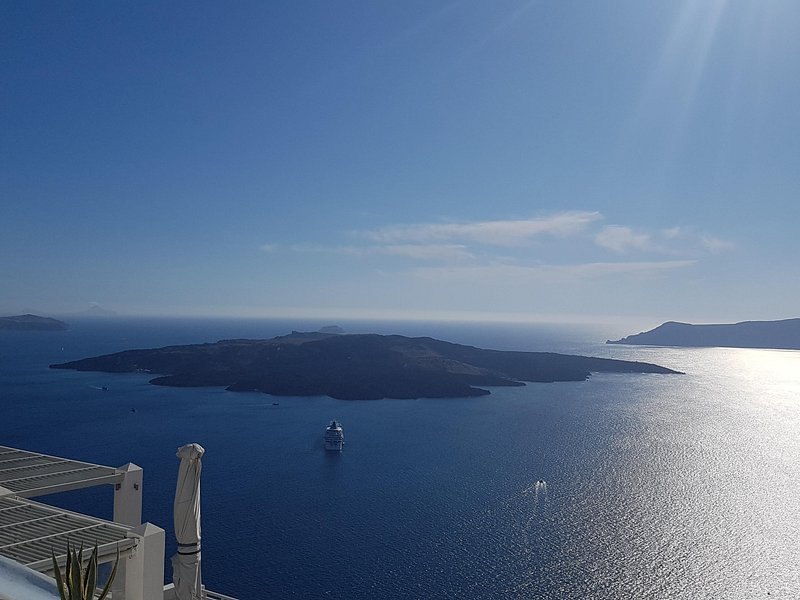
The caldera holds five islands. Thera is the big crescent you are staying on, Thirasia broke away on the far side, Aspronisi is a fragment, and the two Kameni islands sit in the middle. Those two are the volcano.
Nea Kameni is the younger and larger, a bare cone of black scree with a crater path to the top. It last erupted between January and February 1950. Palea Kameni, older and lower, has the warm sulphur springs in a shallow bay on its northern side.
Santorini is the most active volcanic centre in the South Aegean Volcanic Arc and one of the world’s sixteen Decade Volcanoes. That is the reason there is a national geological park out there at all, and the reason it costs EUR 5 to land.
Can you reach the volcano independently?
Not without a boat, and not on any scheduled service. There is no public ferry to Nea Kameni, no bridge and no road. Every visitor who has ever stood on that crater rim got there on a boat somebody else was running.
What people mean by ‘independently’ is a short crossing from the Old Port below Fira, bought on the day, with no guide and no itinerary beyond the landing and the springs. That does exist. It is a boat ticket rather than a tour, and it puts you on the rock for an hour or two.
So the real question is not whether you can avoid a boat. It is whether the cheapest boat, plus your own time, comes out ahead of a full day that somebody has already organised. The guided crossings all sit on the Santorini Greece Tours home page with what each one includes.
The two routes, priced
Here is the comparison with the numbers that are actually published. The independent column assumes you are staying in or near Fira and walking down to the Old Port, which is the cheapest honest version of it.
| Independent crossing | Full-day volcano boat | |
|---|---|---|
| Fare | Bought on the day at the Old Port | From $66 |
| Park fee | EUR 5, cash, at the landing | EUR 5, cash, at the landing |
| Getting to the boat | Cable car EUR 10, or the footpath | Hotel pickup included |
| Getting back up | Cable car EUR 10 again | Included, dropped at your hotel |
| What you see | Nea Kameni, usually the springs | Nea Kameni, springs, Thirasia, Oia |
| Length | Two to four hours | About 14 hours |
| Guide | No | Yes |
| Cancellation | Whatever the ticket says | Free 24 hours ahead |
Two cable car fares and a boat ticket rarely leave much change against $66 for a day that also crosses to Thirasia and ends in Oia.
The EUR 5 fee nobody includes
Nea Kameni is a national geological park and landing on it costs EUR 5 per person, collected in cash on the rock. No boat fare on this island includes it, guided or not, and there is no card payment at the landing.
It is also the most reliable way to tell whether a boat actually lands. A listing that names the EUR 5 fee in its exclusions is telling you it goes ashore. A listing that mentions the volcano and never mentions the fee is usually one that sails past it.
What the crater walk is like
It is a graded path over loose volcanic scree, and it climbs steadily from the landing to the rim. There is no shade anywhere on it. Most people take between 20 and 40 minutes each way, and the boats allow for that.
Trainers or walking shoes rather than sandals: the scree is sharp and it moves under you. In July and August, with average highs of 27 C and no cover, take more water than you think you need. There is nowhere to buy any on the island.
At the top you get steam vents, a smell of sulphur and the whole caldera laid out around you, with the cliffs of Thera on one side and Thirasia on the other. It is the one view that explains the shape of the place.
The hot springs, honestly
They are warm rather than hot, they are rust-coloured from the iron in the water, and you reach them by swimming from the boat across a stretch of noticeably colder sea. Nobody warns you about that last part.
The iron stains light fabric, so wear dark swimwear you are not attached to. The swim itself is short. Whether it is a highlight or a curiosity depends almost entirely on what you were expecting, and curiosity is nearer the mark than highlight.
How long does each route take?
The independent crossing is a half-day at most: down to the Old Port, across, an hour or two on the rock, back. If your holiday is short and the volcano is one item on a list, that is a genuine advantage over a fourteen-hour commitment.
The guided day is a whole day, and it is not padded. Nea Kameni, the springs, a crossing to Thirasia with lunch ashore, then Oia in time for the sunset. For $66 that is a great deal of caldera for the money.
Does a guide add anything on a bare rock?
More than you would guess, because nothing on Nea Kameni is labelled and the interesting part is invisible. The last eruption was in 1950, the caldera reaches 385 metres deep, and the Late Bronze Age eruption that made it ejected somewhere between 28 and 41 cubic kilometres of rock.
Even the date is contested. Archaeological chronology puts the eruption around 1500 BC; radiocarbon puts it between roughly 1645 and 1600 BC; tree rings say 1628 BC. The ranges do not reconcile, and a guide who tells you that is more use than one who picks a number.
When the independent route stops working
Out of season, most of it. The small boats from the Old Port run on demand and demand collapses in winter, and the cable car itself drops to two short blocks a day from December to February.
The weather backs that up: 41 per cent of January days and 44 per cent of February days reach Beaufort 6 or more, against 11 per cent in May and June. From November to March, treat the volcano as a maybe rather than a plan.
What Thirasia adds, and why you cannot get there alone
Thirasia is the piece of the story the independent crossing leaves out. It broke away from Thera in the same collapse that made the caldera, it has a few hundred residents, and no coach has ever reached it because there is no road from anywhere to anywhere.
The full-day boat stops there for lunch, and it is the part of the day people describe afterwards rather than the crater. A working island with a harbour, a staircase up the cliff and no shops selling fridge magnets is a genuinely different experience from Oia at five in the afternoon.
You cannot buy a ticket to it on the day at the Old Port. Getting there means either the day boat or a private charter, and the charter costs several times what the day boat does.
Is it safe to stand on an active volcano?
Yes, under the terms the park operates on. Nea Kameni is monitored, the crater path is graded and maintained, and the last eruption was in 1950 — well within living memory but a long way from imminent.
What actually hurts people out there is the ordinary stuff. Loose scree, no shade, 27 C in August and a climb longer than it looks from the boat. The sulphur smell near the vents is strong rather than harmful, though it is worth knowing about if you have a respiratory condition.
The one real hazard is the schedule. Boats leave on time and the walk back down takes longer than the walk up feels like it should. Keep an eye on the clock at the rim rather than on the way there.
Which route is right for you
Take the independent crossing if you are staying in Fira, you only want the crater, and you have a spare morning rather than a spare day. It is the faster answer and it is not much cheaper once the cable car is in the sum.
Take the guided day if you want the caldera rather than one rock in it. Thirasia has no road from anywhere, the springs need a boat, and Oia at sunset is the end of the day rather than a separate expedition.
Volcano questions
Can you walk to the Santorini volcano?
Is there a public ferry to Nea Kameni?
How much does it cost to land on the volcano?
Is the volcano still active?
How hard is the walk to the crater?
Next: the geology in more detail, or every boat tour on the island with prices.